Thursday, March 13, 2014

Braving the Bitter Cold for the American Bittern

On my birthday, in mid-December, I dragged my entire family -- parents, husband, and 4-year-old son -- to find an American Bittern. We drove to Prairie Ridge Ecostation in Raleigh, NC, following a trail of eBird and list-serv sightings of this bulky brown and tan bird in the Heron family (Ardeidae).

On a crisp, clear winter's day, we slowly walked around one cattail fringed pond, stopping every so often to carefully eye the reeds. We knew that the American Bittern was a camouflage expert: its brown and tan vertical stripes help it fade into the winter-bleached cattails just as much as its awkward stance, with its long beak pointed into the air. The first pond yield no bittern. We walked on to the next. Eventually, fingers chilled and faces frozens, we walked back across the stark field to our car, heads hung with the weight of failure.

Over a month later, I saw another posting about the American Bittern at Prairie Ridge Ecostation. Again, I dragged my family back out. This trip ended in failure too. I was devasted because I knew the bittern wouldn't stick around much longer. American Bitterns will spend the winter in much of North Carolina, feeding on crayfish and frogs without having to bore through a thick layer of ice. But in spring, the American Bitterns leave North Carolina, and head to their breeding grounds in the northern United States and Canada. Lamenting another lost opportunity, we ate away our sorrows at the local Ben and Jerry's.

Yesterday, I saw another posting about the American Bittern. A lady, much like me, had visited the site three times before finally seeing it. I decided to drag my family out to Prairie Ridge Ecostation one last time. As we walked around the first pond, my heart began to sink. Nothing. We headed to the smaller, cattail-filled pond. We walked halfway around this little pond when I saw a strange bit of dark brown mixed into the pale cattails, my eyes finally focused in on the elusive American Bittern.


At first it seemed frozen in its strange beak-up pose. Then it was comfortable preening in front of us, and the bittern even ate a little something it grabbed out of the shallow pond. The bittern moved with great speed and precision, each movement efficient and graceful.

I had finally found the American Bittern at Prairie Ridge. And I even got to take it home with me. When we discovered the bittern, my son magically transformed himself from a little boy uninterested in birds into a keen mimic of the American Bittern. Later he told me that "the bird" was the most beautiful thing that he had seen today.


Tuesday, March 4, 2014

Eastern Garter Snakes: Mating Balls & Sex in the Trees

Last week, Duke Forest staff photographed Eastern Garter Snakes (Thamnophis sirtalis sirtalis) intertwined on the forest floor. They had a discovered a "mating ball" of small males vying for the chance to fertilize a mature female.


Eastern Garter Snakes mating in the Duke Forest, February 20, 2014; Photo courtesy of Sara Childs.

Other garter snake species are better known for their mating balls, including the Red-Sided Garter Snake (Thamnophis sirtalis parietalis). In Manitoba, as many as 25 male Red-Sided Garter Snakes will compete for the chance to fertlize one female, with hundreds of snakes congregating in spring outside their hibernacula or winter dens. The females release a pheromone that drives male Garter Snakes wild (video link here).

Both Eastern Garter Snakes and Red-Sided Garter Snakes have been documented to mate in the trees, a full yard off the ground. Researchers believe that Garter Snakes are driven to arboreal mating by their thermoregulatory needs -- it's easier to make sweet snake love while warm. Typically, Garter Snakes are only seen mating in trees after a rain. The rain cools the ground, but the trees and shrubs remain warmer at air temperature. On sunny days, the ground tends to be warmer than trees, and Garter Snakes are more likely to be seen mating there.


Friday, February 14, 2014

American Beech

“[The] Beech is identifiable by the gleam of its wondrously smooth bark, not furrowed even by extreme old age. Here it will be free of branches for full half its height, the sturdy boughs then gracefully down-sweeping. The gray bole has a further beauty in the way it flutes out at the base into strong feet, to the shallow, wide-spreading roots. And the luxuriant growth of mosses on the north side of such a tree, together with the mottling of lichens, add to the look it ears of wisdom and serenity.” – Donald Culross Peattie, 1948, A NaturalHistory of Trees of Eastern and Central North America
Beech nut
The American Beech (Fagus grandifolia) is never more beautiful than in winter, with its slender branches outlined in ice, their downward sweep extended by stubborn leaves that refuse to fall. It's beauty has been noted by both eminent naturalists and giddy couples seeking to etch their love permanently into its smooth gray bark.

Found across eastern North America, west to Minnesota and south to Texas, the American Beech populates hardwood forest and well-drained bottomlands. It can be recognized by its alternate, elliptical leaf with sharply incurved teeth, its lancelike pseudoterminal buds, and its small nut encased by a prickly husk. 

Two varieties of American Beech are known to occur in North Carolina. Fagus grandifolia var. caroliniana occurs in the Piedmont and Coastal Plain, and it is recognized by the fuzzy hairs on the underside of its thin leafFagus grandifolia var. grandifolia occurs in the mountains and is hairyless or hairy only on the midveins of the leaf. 

Scorias spongiosa on Beech in Durham NC
In many forests of the Piedmont, the beauty of the American Beech is marred only by the Beech Blight Aphid and the dense black fungus (Scorias spongiosa) that grows on the aphids' honeydew. Yet, with dense snow covering the ground and base of the trunk, even this cannot detract from the grace of the American Beech.

Thursday, February 13, 2014

What is the coldest environment birds can tolerate?

A Triangle Naturalist reader recently asked: "Is there a temperature limit past which birds can no longer withstand the elements?"

While many bird species migrate to avoid to the chill of winter in temperate climates, some species, like the Emperor Penguin live year-round in frigid Antarctica, where temperatures can dip below -76°F and winds roar at 100 mph.

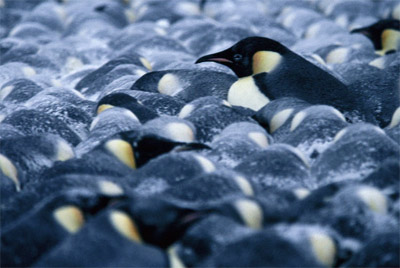
Emperor Penguins maintain their body temperature through a number of adaptations. While cozying up en masse, Emperor Penguins also rely on their specialized circulatory system, a thick layer of blubber, and densely packed feathers to stay warm.

Emperor penguin huddle
Emperor Penguins huddle to stay warm. Photo from Warner Bros at http://www.coolantarctica.com/Antarctica%20fact%20file/science/cold_penguins.htm

Birds in the Piedmont of North Carolina, and the upper Midwest, stay warm using similar adaptations. Some species will huddle together, with the birds at the end regularly switching places with the birds in the toasty middle. Ducks and gulls, for example, have specialized circulatory systems in their feet allowing for counter-current exchange, where warm blood leaving the body heats up the cold blood coming back into the body from feet sitting in icy water. Downy feathers also provide insulation against severe cold.

To return to our reader's question -- is there a temperature limit past which birds won't survive? -- my reply is that there must be, but of all the vertebrate taxa in the world, birds have managed to endure cold the most successfully.

Wednesday, February 12, 2014

Where do birds go when it snows?

On days like this, when the snow drifts down steadily in large, dense clumps, where do all the birds go?

Many birds species spend the winter in the Piedmont of North Carolina. Some species, like Carolina Chickadees and Tufted Titmice, spend their time in mixed foraging flocks, searching for food sources as a group. Other species, like the American Robin, will spend their time in groups of their own species.

During inclement weather, like a snow storm, most birds will huddle in the crevice of a tree branch, trying to find shelter from the cold and wet. Some species will hang tight to the trunk of a tree. Yellow-Bellied Sapsuckers use their special, zygodactyl feel (i.e., 2 toes facing forward, 2 toes facing back) and stiff tail feathers to brace themselves tight again a large pine or hardwood.

In this photo, naturalist Will Cook has perfectly captured the zygodactyl feet of the Yellow-Bellied Sapsucker. If you'd like to see more of Will Cook's fantastic photos, visit his website at http://www.carolinanature.com/birds/.

If the birds are hungry enough, they will come out of their relatively warm resting spots for a high quality food source, like the shriveling fruits of the beauty berry bush or seed offered by a bird-loving homeowner.

Monday, September 9, 2013

Return to Flat River Impoundment (Durham County, North Carolina)

Every September, many local lepidopteraphiles (butterfly lovers) make a pilgrimage to the Flat River Waterfowl Impoundment in north Durham county, North Carolina. Located just north of Historic Stagville along Old Oxford Highway, the impoundment offers a gravel loop trail through wetland habitat. The area abounds with alternate wingstem (Verbesina alternifolia), passionflower (Passiflora incarnata), (Helenium amarum), and willows (Salix spp), all of which are attractive to adult butterflies or their larvae.

Cardinal Flower (Lobelia cardinalis© N. Cagle 2013

Time: 10:30AM to 12:00PM    
Date: Sunday, September 8, 2013
Weather: Full sun; 85-90°F
Butterfly Count: 14 species

  • Cabbage White - 1
  • Question Mark - 1
  • Hackberry Emperor - 8
  • Tiger Swallowtail - 4
  • Clouded Sulphur - 2
  • Orange Sulphur - 10
  • Cloudless Suphur - 11
  • Variegated Fritillary - 3
  • Pearl Crescent - 3
  • Common Buckeye - 13
  • Viceroy - 8
  • Clouded Skipper - 3
  • Fiery Skipper - 1
  • Red-spotted Purple - 2
Today, as we started walking the trail at the Flat River Waterfowl Impoundment, Buckeyes frequently intercepted our path. Occasionally, they were accompanied by Clouded Skippers. In years past, we have seen a much larger number and variety of skippers, although we often go two to three weeks later in the season.
Common Buckeye © N. Cagle 2013

Clouded Skipper © N. Cagle 2013
 Further down the trail, a large willow -- which we call "the butterfly tree" -- was alive with Hackberry Emperors and Horseflies gleaning sap. Beneath the willow, a Question Mark hung upside-down from a blackberry (Rubus spp).

Question Mark © N. Cagle 2013


Red-Spotted Purple © N. Cagle 2013
 Dung piles are excellent microhabitats for beetles, flies, and butterflies. On one pile of raccoon scat (filled with crayfish and persimmon seeds), we found a Viceroy and Hackberry Emperor competing for the rich trove of much needed nutrients, included salts and amino acids.
Viceroy © N. Cagle 2013

Hackberry Emperor © N. Cagle 2013
 As the morning heated up, we were greeted by the bright orange of the Fiery Skipper. We also saw three Variegated Fritillaries near blossoming Passiflora incarnata, a known host for Variegated Fritillary caterpillars.
Fiery Skipper © N. Cagle 2013

Variegated Fritillary © N. Cagle 2013


Saturday, September 7, 2013

Spiders along the Eno River

Spiders Along the Eno River

As summer seeps away in the Piedmont, spiders begin to spin their webs in earnest. Those of us hiking off the beaten path, in particular, will fight our way through a series of webs spun by prodigiously productive orbweavers (Families: Tetragnathidae, Nephilidae, and Araneidae).

Photographs of some common spiders in the Piedmont appear below. 


Orchard Orbweaver (Leucage venusta© Nicolette L. Cagle 2013

Triangulate Orbweaver (Verracusa arenata© Nicolette L. Cagle 2013

Unidentified Orbweaver © Nicolette L. Cagle 2013

Spined Micrathena (Micrathena gracilis© Nicolette L. Cagle 2013

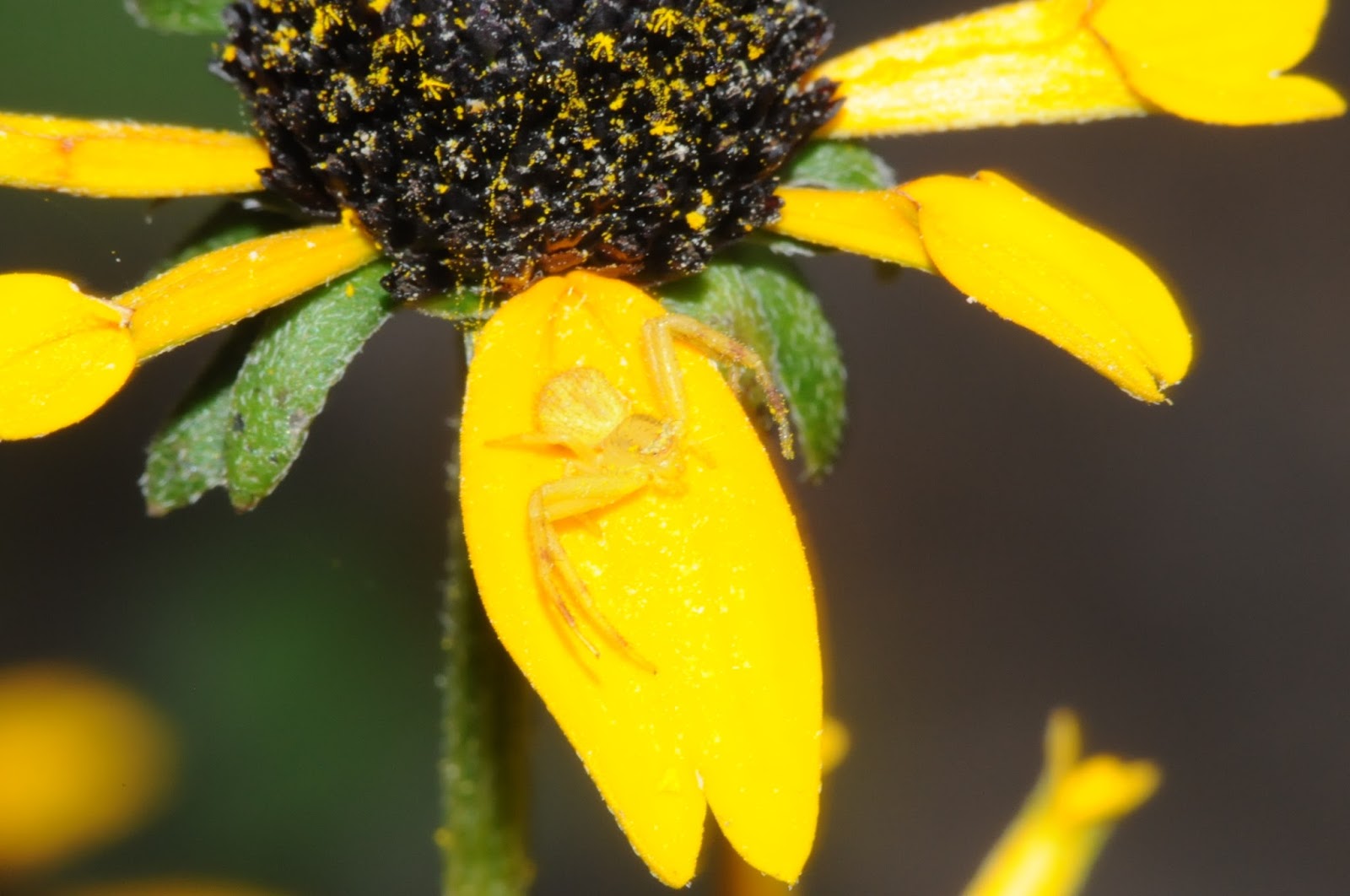
Crab Spider (Family: Thomisidae)


Thursday, August 29, 2013

Excellence in EE Awards: Call for Nominations

Excellence in EE Awards: Call for Nominations

Help NAAEE recognize individuals and organizations that excel in EE by nominating them for one of our annual awards, including our highest honor, the Walter E. Jeske Award. Online nominations forms are linked here: www.naaee.net/programs/awards

Nomination Deadline is August 30!


Tuesday, July 30, 2013

Environmental Educators of NC: Call for Nominations

This is your last chance to nominate someone or someplace for a 2013 EENC Annual Award.


Award categories include:
Environmental Educator of the Year: for an individual who excels at helping others learn and lead

Exceptional Environmental Education Program: for a project, center, museum, unique program that helps people become more environmentally literate and knowledgable.

Outstanding Partnership: for a group, business, or organization that helps make environmental education possible.

Keith Bamberger
EENC Membership Co-Chair


Reposted from NC-EE Listserv

Sunday, July 14, 2013

New Hope Bottomlands Trail (Durham, NC)

New Hope Creek Bottomlands Trail (Durham NC)

Access: The New Hope Creek Bottomlands Trail is a 2.2 mile loop located off of SW Durham Drive in south Durham. The access point at Sherwood Githens Middle School is currently closed, so the best way to access the trail is to park by the dumpster in parking lot of the North Carolina Orthopaedic Center (3609 SW Durham Drive), walk down the sewer line easement, make a left at the first easement on the left, and reach the trail head on the right. 

Trail head of the New Hope Creek Bottomlands trail. Additional information about the site can be found at the New Hope Creek Corridor Advisory Committee website.
Map of bottomlands trail route.
What to expect: The New Hope Creek Bottomlands Trail loop winds through mixed hardwood forest. Expect to see stands of pawpaw, towering oaks, and other bottomland tree species. A part of the trail also runs adjacent to New Hope Creek. Please note that after heavy rains the trail does flood. The most recent rains have dislodged some of the new boardwalks. Be prepared for mosquitoes and muddy, wet trails.  Additional information about the site can be found at the New Hope Creek Corridor Advisory Committee website.

Sewer line easement near dumpster of North Carolina Orthopaedic Center (3609 SW Durham Dr). Use this entrance until the Sherwood Githens Middle School access point become available.

Common pawpaw (Asimina triloba) typically occupies low woods and floodplain habitats in NC. It is easily recognized by its rusty colored, paint brush-like buds and magnolia-like leaves. In spring, gorgeous maroon colored flowers -- pollinated by flies -- adorn these small trees. 

Enormous northern red oak (Quercus rubra). 

Two species of mulberry are common the North Carolina Piedmont. One species, white mulberry (Morus alba) is non-native. You can recognize the non-native mulberry by its relative smaller leaves that are glabrous (or smooth) above. This photo show the native red mulberry that has relatively larger leaves that are scabrous (or rough) above and pubescent (or fuzzy) below. 


A fallen tree provides wetland habitat in the bottomlands of New Hope Creek.

A southern leopord frog (Rana sphenocephalus).

New Hope Creek turbid from high sediment run-off.