Monday, August 1, 2011

GREAT EXPECTATIONS: August in the Piedmont

Birds.− In August, migrants such as chestnut-sided warblers, magnolia warblers and blackburnian warblers begin to pass through North Carolina as they head towards the neotropics for the winter. These warblers will be duller colored than they were in the spring, having lost their vibrant breeding plumage and molted into drabber winter attire.

Vermivoric warblers (i.e., those that eat worms), which stop in the Piedmont for a quick meal before heading further south, can often be found with “friends”. This time of year, experienced birders will often search for American redstarts and black-and-white warblers by first finding a group of more easily located Carolina chickadees and tufted titmice.

Did you know that warblers were the subject of classic ecological study by Robert MacArthur (1930-1972)? Before MacArthur’s study, people thought that five species of warblers -- Cape May, yellow-rumped, black-throated green, Blackburnian and bay-breasted – actually occupied the same “niche” since they all used the same breeding grounds. By watching foraging warblers and dividing individual trees into vertical and horizontal observational zones, MacArthur found that each warbler species actually used a different part of the tree. For example, the bay-breasted warbler fed around the middle-interior of the trees, while the Cape May warbler stayed toward the top-outside of trees. MacArthur showed that the warblers were dividing up a limited resource, a phenomenon now known as “niche partitioning.”

Butterflies.− Expect a pulse in the migrant cloudless sulphurs and little yellows and lookout for the 2nd and 3rd broods of the tawny and hackberry emperors, respectively.

Also, expect to see a continued rise in swallowtail sightings, this month, after the mid-summer lull. In fact, very lucky lepidopterists (i.e., butterfly observers) might even come across a bilateral gynandromorph tiger swallowtail, like the one that was seen last year in Hillsborough. A gynandromorph is an organism that has both male and female characteristics; bilateral gynandromorphs are half male and half female and mosaic gynandromorphs are a mix of each. Gynandromorphs are the product of sex chromosomes that do not split apart in the typical way during the first division of the zygote (i.e., the fertilized egg).

Reptiles & Amphibians.− Keep an eye out for snakes and turtles, especially baby box turtles, which begin to hatch this month. Fence lizards and skinks are also out in abundance. Green anoles can also be sighted. Listen for large choruses of green tree frogs and bullfrogs, as well as occasional calls from eastern narrow-mouthed toads and eastern spadefoots.

Other Insects.− Expect a pulse in grasshopper and cicadas activity this month. You might also find dead or dying luna moths this time of year. August marks the time of their third and final brood of the summer.

Did you know?

· The luna moth is one of the largest moths in the United States, with lime-green wings expanding to nearly four and a half inches.

· Luna moths only live for 1 week!

You may also see green lacewings flying around in the evenings. Lacewings are fascinating insects that are important predators in many agricultural systems. They consume aphids and other soft-bodied insects. Predators of lacewings include bats and spiders. Interestingly, lacewings are sensitive to the frequencies emitted by bats when hunting and will try to evade them. Lacewings also will not struggle in a spider web, but attempt to free themselves by chewing the strands of the web.

In Bloom this Month.− Be on the lookout for some striking August flowers:

In Bloom:

SMALL-FRUIT AGRIMONY – Agrimonia microcarpa

AMERICAN BEAUTY-BERRY -Callicarpa americana

TRUMPET-CREEPER – Campsis radicans

TICK-TREFOIL – Desmodium nudiflorum

DEVIL'S-GRANDMOTHER - Elephantopus tomentosus

JOE-PYE-WEED – Eutrochium (syn.Eupatorium) dubium

SNEEZEWEED – Helenium autumnale

SCARLET ROSE-MALLOW – Hibiscus coccineus

ST. ANDREW’S CROSS - Hypericum hypericoides

CARDINAL-FLOWER – Lobelia cardinalis

GREAT BLUE LOBELIA – Lobelia siphilitica

CORAL HONEYSUCKLE(S) - Lonicera sempervirens

BLACK-EYED-SUSAN - Rudbeckia fulgida

GREEN-HEAD CONEFLOWER – Rudbeckia laciniata

ROSINWEED – Silphium sp.

AXILLARY GOLDENROD - Solidago caesia

ANISE-SCENTED GOLDENROD – Solidago odorata

IRONWEED – Vernonia sp.

Piedmont Habitats.− Did you know that oak savanna once stretched across North Carolina’s Piedmont?

The savanna community consisted of grasses and forbs under a thin canopy of oaks and sometimes graded into true prairie. This system was documented by a number of North Carolina’s early explorers and settlers, including John Lawson and Bishop August Gottlieb Spangenberg. While traveling around the Yadkin River in the mid 1700s, Lawson noted that he had “travell'd, this day, about 25 Miles, over pleasant Savanna Ground, high, and dry, having very few trees upon it, and those standing at a great distance. The Land was very good, and free from Grubs or Underwood.”

The Piedmont savanna was formed and maintained by a variety of factors, including climate, characteristic soil types (including saturated, basic or droughty soils), both natural and American Indian set fires, and perhaps grazing by now diminished herbivores, such as bison. Now nearly gone in North Carolina, Piedmont savannas were incredibly diverse, containing nearly 300 plant species. Johnny Randall, the assistant director for conservation and natural areas at the UNC Botanical Garden, is optimistic about restoration efforts for this community type. Local savanna restoration sites include Penny’s Bend Nature Preserve and parts of Mason Farm Biological Reserve.


References:

Cook, D. 2001. The Piedmont Almanac. Raleigh, NC: Barefoot Press.

Daniels, J. C. 2003. Butterflies of the Carolinas. Cambridge, MN: Adventure Publications, Inc.

Ehrlich, P., D. Dobkin, and D. Wheye (1988). The Birder's Handbook. New York: Simon & Schuster.

Juras, P. 1997. The Presettlement Piedmont Savanna - a Model for Landscape Design and Management. University of Georgia Master’s Thesis.

Friday, July 1, 2011

GREAT EXPECTATIONS: July in the Piedmont

Birds.− This month, lucky birdwatchers may catch a glimpse of rare common mergansers, tricolor herons, little blue herons and snowy egrets. Also, sandpipers are beginning to return to the Piedmont. The melodious songs of most bird species begin to disappear this month, although the indigo bunting can still be heard from its high perch.

Populations of the indigo bunting (Passerina cyanea) have steadily increased in abundance since the 1900’s, despite being vulnerable to cowbird parasitism. These brilliant blue finches prefer to breed in forest edges, open woodlands, weedy fields and orchards. As Piedmont habitats become increasingly fragmented (a process detrimental to many bird species), more edge habitat is available for nesting indigo buntings. Indigo bunting nests can be found one to 15 feet off the ground in tree tangles, and consist of woven grass, leaves and bark. The nests may even include snake skin, and they are often lined with fine grass, cotton, feathers and even hair. The female primarily cares for the young that hatch from the small (0.8”) white to light blue eggs. In summer, the indigo bunting displays sexual dimorphism, making it easy to distinguish the vibrant blue males from the brown females. In winter, indigo buntings will join flocks of other finch species and shift their diet from primarily insects to seeds.

In July, remember to look for anting behavior, when birds carefully arrange themselves on top of an ant hill or vigorously rubbing its feathers with an ant. Summer and year-round residents that are known to engage in anting include the yellow-billed cuckoo, mourning dove, common flicker, brown thrasher and pine warbler.

Remember: Give those fledglings a fighting chance by KEEPING CATS INDOORS.

Butterflies.− This month the grass skipper doldrums begin, but grass skipper activity should increase by the end of the month. Also, the flight of the common wood nymph is just beginning, so you may see some fresh (i.e., newly emerged) ones out and about. Lucky observers may also see fresh Appalachian browns and tawny emperors.

Also, observant naturalists and gardens may notice large green caterpillars with black and orange markings munching away on flowers in the Carrot family this month, or you might even see strange, greenish-brown cocoons hanging from plants (see video of the process). Most likely, you are witnessing black swallowtail (Papilio polyxenes) larvae in action. In fact, the black swallowtail is one of the most commonly seen garden butterflies. Males are recognized by their jet black wings lined with yellow-orange bands, a few blue spots and a single black-eyed orange spot. The female is mostly black with lines of yellow and blue spots. After a female black swallowtail lays yellowish eggs on a member of the Carrot family, it takes a few days to hatch into a caterpillar. The caterpillar will go through five instars (or stages, click here for more information) before transforming into a chrysalis. After about 10 days, a butterfly will emerge from the chrysalis, although in some cases, the chrysalis will over-winter.

Reptiles & Amphibians.− Keep an eye out for snakes and turtles this month, their eggs are still incubating, but some may hatch towards the end of the month. Fence lizards and skinks are also out in abundance. Large choruses of Cope’s gray treefrogs, green tree frogs, bullfrogs and green frogs can still be heard this month. Also listen for eastern narrow-mouthed toads and eastern spadefoots. Cope’s gray treefrog froglets will continue to emerge from ponds and wetlands this month.

Other Insects.− Cicadas and katydids will be chorusing in earnest this month. Also, lookout for increased numbers of Japanese beetles, a pest that arrived from Japan in 1916. This month, a number of large and fascinating beetles can be found in abundance. Some species you might see (with identifying traits in parentheses) include: fiery searchers (up to 1.5 inches long, with greenish, lined wings), Bess beetles (large black beetle with small horn), Hercules beetles (army green with black spots; males have two horns -- one on the thorax and one on the head), and reddish-brown stags (reddish-brown beetles, with “antlers”).

In Bloom this Month.− Lookout for some striking July flowers and their amazing array of pollinators. Ever wonder why flowers come in such a diversity of shapes, sizes and colors? They are meant to attract different pollinators. Orange flowers, like butterflyweed, and purple flowers, like purple-coneflower, primarily attract butterflies although other pollinators will visit these floral gems as well. Tubular red flowers with copious and sweet nectar, like cardinal flower and trumpet creeper, are very attractive to hummingbirds.

In Bloom:

SMALL-FRUIT AGRIMONY – Agrimonia microcarpa

SWAMP MILKWEED – Asclepias incarnata

DOWNY YELLOW FALSE-FOXGLOVE – Aureolaria virginica

AMERICAN BEAUTY-BERRY – Callicarpa americana

TRUMPET CREEPER - Campsis radicans

GREEN-AND-GOLD – Chrysogonum virginanum

WHORLED TICKSEED – Coreopsis verticillata

TICK TREFOIL(S) – Desmodium spp.

INDIAN-STRAWBERRY – Duchesnia indica

PURPLE-CONEFLOWER – Echinacea spp.

EASTERN DAISY FLEABANE- Erigeron annuus

NORTHERN RATTLESNAKE-MASTER – Eryngium yuccifolium

THOROUGHWORT – Eupatorium spp.

WHITE AVENS – Geum canadense

SCARLET ROSE-MALLOW – Hibiscus coccineus

ST. ANDREW’S-CROSS – Hypericum hypericoides

VIRGINIA BUNCHFLOWER –Melanthium virginicum

SUMMER PHLOX – Phlox paniculata

AMERICAN LOPSEED – Phryma leptostachya

BLACK-EYED-SUSAN(S) – Rudbeckia spp.

HOARY SKULLCAP – Scutellaria incana

STICKY ROSINWEED – Silphium glutinosum

STARRY ROSINWEED –Silphium asteriscus

AXILLARY GOLDENROD – Solidago caesia.

STOKES’-ASTER – Stokesia laevis

IRONWEED – Vernonia spp.

Piedmont Habitats.− Have you ever wanted to identify characteristics of a forest or habitat by a few key plant or animal species or cues from the landscape? Old hayfields are usually dominated by grasses and legumes, while former pasture land (i.e., grazed) is often home to eastern red cedar, thistle and dense fescue.


References:

Burt, W. H. and R. P. Grossenheider. 1980. A Field Guide to the Mammals, 3rd ed. Boston, MA: Houghton Mifflin Company.

Cook, D. 2001. The Piedmont Almanac. Raleigh, NC: Barefoot Press.

Daniels, J. C. 2003. Butterflies of the Carolinas. Cambridge, MN: Adventure Publications, Inc.

Ehrlich, P., D. Dobkin, and D. Wheye (1988). The Birder's Handbook. New York: Simon & Schuster.

Elbroch, M. 2003. Mammal Tracks and Signs A guide to North American Species. Mechanicsburg, PA: Stackpole Books.

Wagner, D. L. 2005. Caterpillars of Eastern North America. Princeton University Press: Princeton, NJ


Wednesday, June 1, 2011

GREAT EXPECTATIONS: June in the Piedmont

Birds.− This month, look for sunning birds. Common backyard birds, like cardinals and robins, perch with feathers ruffled and bills agape, soaking in the sun. This activity may help them molt or even reduce tick, lice and other parasite loads.

Also, fledging season continues. The second batch of young-of-the-year bluebirds often fledge in June. Ruby-throated hummingbirds, prothonotary warblers, house wrens, tufted titmice and bald eagles have also been documented to fledge in the Piedmont in June.

By now, a number of sparrow species (e.g., savannah, Lincoln’s, swamp, white-throated and white-crowned) have left North Carolina, only to reappear in September. But lucky bird watchers may be able to spot rare little blue herons and Caspian terns this month.

Have you ever noticed the sound of a crow with a strikingly nasal call? Then you may have heard a fish crow (Corvus ossifragus). The Piedmont of North Carolina is home to two crow species, the American crow (Corvus brachyrhynchos), with its clear cawing voice, as well as the fish crow. The two birds are difficult to tell apart, both are year-round residents that don all black plumage. The fish crow is slightly smaller and its bill is slightly thinner, but the most diagnostic way to tell these two species apart is by ear.

Remember: Give those fledglings a fighting chance by KEEPING CATS INDOORS.

Butterflies.−. This month, you will find some butterfly species busily visiting flowers, in search of nectar. On common milkweed (Asclepias syriaca) alone, expect to see multiple butterfly visitors including great spangled fritillaries, tiger swallowtails, monarchs and silver spotted skippers. In June, the abundances a few species peak, including the coral and banded hairstreaks and great spangled fritillaries. By the end of the month, expect to find little yellows, gulf fritillaries and more common wood nymphs.

The North Carolina Piedmont hosts a number of broods of variegated fritillary. With the peak in fritillary (members of the Nymphalidae) activity this month, it might be useful to identify their distinctive caterpillars. Variegated fritillary caterpillars are longitudinally striped with orange and white bands, and are sparsely peppered with black spines. They can be found on violets and Passion flower vines. Although the great spangled fritillary is out this month, this species won’t begin laying eggs until late summer and early fall. The black caterpillars, with orange spines, can sometimes be found on violets in the winter and early spring.

Don’t forget: The Carolinas are home to five families of butterflies: the skippers (Hesperiidae), gossamer wings (Lycaenidae), brush-foots (Nymphalidae), swallowtails (Papilionidae) and the sulphurs and whites (Pieridae). Each of these families can be divided into a number of sub-families with distinct identifying characteristics.

Reptiles & Amphibians.− Don’t be surprised to see a number of snakes this month, sometimes in odd places. Black rat snakes might be found climbing trees, in search of eggs. Northern water snakes could be stuck high in riparian (i.e., river-side) shrubbery following heavy rain. Beautiful pale peach and white copperheads might even be on your driveway in the evening, soaking up warmth from the concrete and asphalt.

Also, this month, many reptiles will be laying eggs, including box turtles, yellow-bellied sliders and a number of snake species. Fence lizard and skinks are also out in abundance. Large choruses of northern cricket frogs, Fowler’s toads, eastern narrow-mouthed toads and Cope’s gray treefrogs can still be heard along with bullfrogs and green frogs. Newly metamorphosed Fowler’s toads will be hopping around at the beginning of the month. At the end of the month, look out for 1 cm long Cope’s gray treefrogs.

Other Insects.− Expect to find tiny green-winged stoneflies and giant stoneflies gathering at night by the light. Giant stoneflies, gray bodied insects stretching about 1.5 inches long with uniquely netted veins, may look intimidating, but are completely harmless. In fact, the adult giant stonefly only lives a few weeks and doesn’t eat at all. The presence of giant stonefly larvae in a rivers and creeks indicates that the stream is healthy and not very polluted.

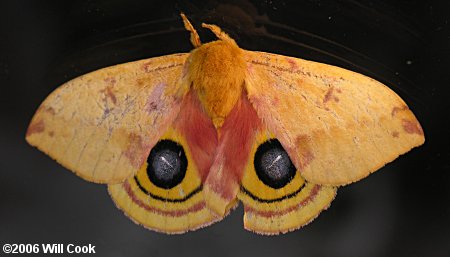
This month, damselflies, which look like dragonflies that close their wings when they land, are out in abundance. Look for the ebony jewelwing -- males have deep black wings and iridescent green bodies, females have tell-tale while spots at the tip of their wings, as well as the American rubyspot – a clear-winged species, painted red near the base with an army-green body. Luna moths have been observed emerging at the beginning of June, while Io moths, with their characteristic eye-spots on the hind wings, can sometimes be seen towards the end of the month.

In Bloom this Month.− Be on the lookout for some of these great June flowers and their pollinators, including a variety of bees, wasps, beetles and bugs!

In Bloom:

TALL THIMBLEWEED - Anemone virginiana

MILKWEED(S) - Asclepias spp.

NEW JERSEY-TEA - Ceanothus americanus

SPOTTED WINTERGREEN –Chimaphila maculata

GREEN-AND-GOLD – Chrysogonum virginanum

TICK TREFOIL(S) – Desmodium spp.

MOCK-STRAWBERRY - Duchesnia indica

EASTERN DAISY FLEABANE - Erigeron annuus

WHITE AVENS – Geum canadense

ST. ANDREW’S-CROSS – Hypericum hypericoides

SESSILE BLAZING-STAR - Liatris spicata

MILKVINES – Matelea spp.

SOUTHERN SUNDROPS - Oenothera fruticosa

PASSIONFLOWERS – Passiflora spp.

AMERICAN LOPSEED – Phryma leptostachya

HOOKED BUTTERCUP - Ranunculus recurvatus

BLACK-EYED-SUSAN - Rudbeckia hirta

ELDERBERRY – Sambucus spp.

SKULLCAP - Scutellaria sp.

FIRE-PINK – Silene virginica

INDIAN-PINK - Spigelia marilandica

STOKE'S-ASTER - Stokesia laevis

SMOOTH SPIDERWORT - Tradescantia ohiensis

Piedmont Habitats.− Have you ever wanted to identify characteristics of a forest or habitat by a few key plant or animal species or cues from the landscape? Close observation of species composition (i.e., the species present) and structure (i.e., the spacing and size of plant species) can tell you a lot about a place. For example, xeric (or dry) forests in the Piedmont can be identified by the presence of blackjack oak and chestnut oak. Dry-mesic (slightly drier than intermediate) sites are often identified by the presence of post oak, black oak and southern red oak.


References:

Burt, W. H. and R. P. Grossenheider. 1980. A Field Guide to the Mammals, 3rd ed. Houghton Mifflin Company: Boston, MA.

Cook, D. 2001. The Piedmont Almanac. Raleigh, NC: Barefoot Press.

Conant, R., and J.T. Collins. 1991. A Field Guide to Reptiles and Amphibians: Eastern and Central North America. Houghton Mifflin Company: Boston, MA.

Daniels, J. C. (2003). Butterflies of the Carolinas. Cambridge, MN: Adventure Publications, Inc.

Ehrlich, P., D. Dobkin, and D. Wheye (1988). The Birder's Handbook. New York: Simon & Schuster.

Goodpaster, W. W. and Hoffmeister, D. F. (1954). Life History of the Golden Mouse, Peromyscus nuttalli, in Kentucky Journal of Mammalogy, Vol. 35, No. 1 (Feb., 1954), pp. 16-27

Wagner, D. L. 2005. Caterpillars of Eastern North America. Princeton University Press: Princeton, NJ

Wednesday, May 25, 2011

iNaturalist Global Amphibian Blitz

Check out the iNaturalist Global Amphibian Blitz: http://www.inaturalist.org/projects/global-amphibian-blitz

According to their website: "AmphibiaWeb, The Smithsonian Conservation Biology Institute, Center for Biological Diversity, the IUCN/SSC Amphibian Specialist Group, and Amphibian Ark are launching the Amphibian Blitz. Visit www.inaturalist.org/projects/global-amphibian-blitz to contribute your observations of amphibians along with the dates and locations where you observed them, anywhere in the world."

Sunday, May 22, 2011

BACKYARD NATURE: Nesting Birds

This month, many bird species are laying eggs, sitting on eggs, hatching young, or resting contentedly after their young have fledged. I took the following pictures of the nests in my backyard alone (22 May 2011):


Brown thrasher eggs. (photo by N. L. Cagle, 22 May 2011)
Northern cardinal young. (photo by N. L. Cagle, 22 May 2011)
Carolina wren nest; the young have already fledged (photo by N. L. Cagle, 22 May 2011)

Monday, April 11, 2011

GREAT EXPECTATIONS: April in the Piedmont

Birds.− This month, spring migrants are headed our way. Some species that may be seen during the next couple months, as they head north, include: some wood-warblers (including golden-winged, Nashville, chestnut-sided, magnolia, black-throated blue, black-throated green, bay-breasted and blackpoll), herons (e.g., little blue heron, black-crowned night heron, cattle-egret), thrushes (e.g., veery, grey-cheeked and Swainson’s) and sandpipers (e.g., spotted and solitary). Also be on the lookout for sora, Virginia rail or a rare glossy ibis.

Some species will be arriving this month with the intention of staying the summer and breeding here in the Piedmont; these include: whip-poor-wills, chimney swifts, ruby-throated hummingbirds, eastern wood-pewees, Acadian flycatchers, eastern kingbirds, northern parulas, prairie warblers, summer and scarlet tanagers and yellow-breasted chats.

Did you know? The spring migration of birds occurs along four principal “flyways” in North America. Lucky for us, the Atlantic flyway crosses North Carolina, and provides a route northward from Central America and the West Indies for about 150 species of migratory birds. Ample food and cover exist along the entire mountain-free flyway, which stretches from the Gulf of Mexico, through the Carolinas and Virginia to the northeastern states and into central Canada.

Butterflies.− In April, butterfly watchers may begin to find some of the skippers (e.g., zabulon, dusted, pepper and salt), duskywings (mottled, zarucco), cloudywings (southern, northern, confused), satyrs (gemmed, Carolina) and pearlyeyes (southern and northern). Silvery checkerspots can be spotted in moist floodplains or sometimes near drier woodland borders, where adults glean nectar from, and caterpillars feed, on sunflowers (Helianthus) and rosinweeds (Silphium spp.). Look for red-spotted purples in hardwoods forests and forest edges; adults may be found taking sustenance from tree sap or damp ground, while caterpillars feed on cherries (Prunus spp.) and other members of the Rosaceae.

Butterfly aficionados will continue to see a number of sulphurs and hairstreaks this month, as well as questionmarks and commas. The most spectacular visitors, this month, may be the monarchs and their mimics, viceroys.

Remember: The Carolinas are home to five families of butterflies: the skippers (Hesperiidae), gossamer wings (Lycaenidae), brush-foots (Nymphalidae), swallowtails (Papilionidae) and the sulphurs and whites (Pieridae). Each of these families can be divided into a number of sub-families with distinct identifying characteristics. This month, we will consider a sub-family of the skippers: the giant skippers (Megathyminae). The giant skippers are larger than other Hesperiidae, yet they are only medium-sized butterflies with relatively thick bodies. They tend to be brown with bright yellow markings. Although adults do not visit flowers, males will guard territories and can be found perched on vegetation. Since the giant skippers are typically found in the deserts of the southwestern United States, North Carolina is only home to two species: the Cofaqui giant skipper (Megathymus cofaqui) and the Yucca giant-skipper (Megathymus yuccae). The Cofaqui giant skipper is a resident of the extreme southwestern portion of the state, while the Yucca giant-skipper can be found in the Piedmont and the Coastal Plain. An uncommon species, the Yucca giant-skipper is typically found near its larval host plant (Yucca spp.) and is usually sighted only in April. To find out more about this species and to view their chimney-like chrysalis, visit Jeff Pippen’s great odonate website.

Other Insects.− This month, field crickets will begin to call, crane flies will hover in the grass and ticks abound.

Reptiles & Amphibians.−

What you’ll hear: Northern cricket frogs, eastern narrow-mouthed toads and Cope’s gray treefrogs will begin to call. American and Fowler’s toads, spring peepers, bull frogs, green frogs, southern leopard frogs and eastern spadefoots will continue to call, but the large choruses of southeastern chorus frogs will be winding down this month.

What you’ll see: Look in shallow permanent or ephemeral ponds to find frog and toad eggs and even tadpoles. In April, visible eggs include the long gray-green strings of Fowler’s toad eggs and globs of gelatinous black spotted Cope’s gray treefrog eggs. In most years, small and dark American toad tadpoles will emerge this month. Also, be on the lookout for basking yellow-bellied sliders and painted turtles. Snakes will be out as well, so be sure not to step on the diminutive and well-camouflaged northern brown snake (Storeria dekayi) when walking on preserve trails. When gardening this month, also watch out for secretive rough earth snakes and eastern worm snakes, North Carolina’s most common snake species.

In Bloom this Month.− April is a wonderful month to test your tree identification skills. Try to identify trees by their bark or buds before they flower and leaf out! In late March and early April, woodland hikers may notice a diminutive plant with three mottled leaves radiating out from the center, topped by a single maroon flower; this is likely one of the Piedmont’s most common trilliums, little sweet betsy or Trillium cuneatum. This musk-scented gem was once used medicinally to treat gangrene and skin ulcers. It is now a favorite among natural landscapers, as it is deer resistant.

References: Cook, D. 2001. The Piedmont Almanac. Raleigh, NC: Barefoot Press. Daniels, J. C. (2003). Butterflies of the Carolinas. Cambridge, MN: Adventure Publications, Inc. Ehrlich, P., D. Dobkin, and D. Wheye (1988). The Birder's Handbook. New York: Simon & Schuster.

Friday, March 11, 2011

GREAT EXPECTIONATIONS: March in the Piedmont

Birds.− As spring arrives in the Piedmont this month, we begin to see some profound changes in the composition of our avifauna. Wood-ducks, blue-winged teals (local breeders), double-crested cormorants and ospreys become more abundant. Also expect to begin seeing vireos, ruby-throated hummingbirds, purple martins and other swallow species this month. Lucky observers may even catch sight of a snowy egret, little blue heron, Mississippi kite, blue grosbeak, indigo bunting or some sandpiper species and early warblers (e.g., black-and-white, prothonotary, yellow-throated, blue-winged, Tennessee). However, don’t expect to catch any more rare sightings of snow geese or mute swans.

In March, many bird species begin breeding and building nests. By the end of the month, they may even be sitting on eggs. This month, you may see both male and female woodpeckers excavating their nests (although the males often do most of the work). Woodpeckers usually excavate a new nest cavity each year, and empty cavities are quickly taken by starlings, sparrows and titmice. Although the trees that they excavate may look alive, research has revealed that most woodpecker species chose to excavate trees with dead heartwood. One exception, found in the North Carolina sandhills, is the red-cockaded woodpecker, which prefers to dig into live pine trees.

Later this month, you may observe a few ruby-throated hummingbirds arriving from the forests and scrublands of Central America at your Piedmont feeder, although sightings typically pick up by the second week of April. In the Piedmont, female hummingbirds construct small nests of soft thistle and dandelion down, placed in a shell of lichen and bud scales held together by spider webs, ten to twenty feet off the ground. These nests may even be reused the next season, following repairs.

Butterflies.− This month, butterfly watchers may begin to find hairstreaks (including the red-banded, gray, juniper, and great purple) and swallowtails (e.g., black and eastern tiger). If you want to find zebra swallowtails, be sure to look in the right sort of habitat: breeding takes place in rich, moist woodlands often near rivers and swamplands. In fact, zebra swallowtail larvae will only feed on paw-paw (Asimina spp.), although adults may fly out to the forest edge to enjoy nectar from a variety of sources including milkweeds (Asclepias spp.) and the eastern redbud (Cercis canadensis).

Lucky observers may find Henry’s elfins and eastern pine elfins, while definitely spotting a lot more cabbage whites, sulphurs, spring azures, question marks, eastern commas and mourning cloaks. Towards the end of the month, keep your eyes open for sleeper, Juvenal’s and Horace’s duskywings, adults of which are often seen perched on bare ground, including dirt roads and trails, where they glean minerals.

Did you know that butterflies have neither lungs nor blood? Both butterflies and caterpillars breathe through small openings along the sides of their bodies, called spiracles. From each spiracle, a tube (i.e., the trachea) carries oxygen into the body. Since the trachea bring oxygen directly to the tissue, butterflies don’t need blood to transport oxygen. Butterflies do rely on a green-colored fluid, called hemolymph, to carry other nutrients (but not oxygen) throughout their body.

Reptiles & Amphibians.− Throughout March, expect to continue hearing southeastern chorus frogs, spring peepers, northern cricket frogs, American toads, pickerel frogs and eastern spadefoots. Fowler’s toads, bullfrogs and green frogs will start calling this month, but don’t expect large choruses until April. March frog call guide:

southeastern chorus frog: raspy, rising call like someone dragging their thumb over the teeth of a comb

spring peepers: a loud, medium pitched “peeep”

northern cricket frogs: clinking like two small metal balls being tapped together

American toads: long, musical trill

pickerel frogs: drawn out snore

eastern spadefoot toads: a crabby, deep “eeeerrrr”

Continue to look for breeding salamanders. This month you may also observe basking yellow-bellied sliders and the occasional black-rat snake or racer warming up in dappled sunlight.

In Bloom this Month.− March is a great month to brush-up on your herbaceous plant identification, starting with the spring ephemerals – fragile wildflowers that disappear after a brief vernal resurgence. One of the first flowers to bloom in March is round-lobed hepatica (Hepatica americana). Other March ephemerals include the spring beauty (Claytonia virginica) and trout lilies (Erythronium americanum) with their yellow nodding flowers emerging from a pair of dark green, spotted leaves. If you’re exploring richer woods, you might find red trillium (Trillium cuneatum), may-apples (Podophyllum peltatum), a few species of wild ginger or heart leaf (Hexastylus spp.) and bloodroot (Sanguinaria canadensis).

Bloodroots are fascinating plants with clasping, multi-lobed dark green leaves from which emerge a delicate 8-12 petaled white flower. Its flowers are pollinated by small bees and flies, and its seeds are dispersed by ants in a process known as myrmecochory. The ants are attracted to a fleshy, edible organ on the seed known as an elaiosome. They bring the seed back to their nest, where they eat the elaiosome, and then deposit the seed in their fertile nest debris!

Soil Series of the Month.− The United States contains over 19,000 different soils series, i.e., the most specific grouping of soils based on shared history, chemistry, and physical properties.

The most general classification of soil is the soil order. Worldwide, there are only 12 soil orders. North Carolina is home to seven: Entisols, Inceptisols, Alfisols, Ultisols, Mollisols, and Spodosols.

Ultisols, the quintessential deep red, clayey soil of the Piedmont, are the most common soil order in North Carolina. Found in humid areas, like the Southeastern United States and Southeast Asia, Ultisols tend to be weathered, low in native fertility, and clayey in the deeper horizons.

North Carolina’s state soil, the Cecil soil series is an Ultisol. Cecil soil, deep red and clayey, develops over igneous and metamorphic rock, with granitic qualities. Virgin Cecil soil support mixed hardwood and pine forest, and usually has a rich, dark colored topsoil. Most Cecil soil isn’t in its virgin state, and this layer of rich soil has been eroded away, exposing the dark red, less fertile subsoil.

References: Cook, D. 2001. The Piedmont Almanac. Chapel Hill, NC: Mystic Crow Publishing. LeGrand, H. E. Jr. 2009. Notes on the Butterflies of North Carolina. Available at: http://149.168.1.196/nbnc/ Martof, B. S., W. M. Palmer, J. R. Bailey, and J. R. Harrison. 1980. Amphibians and Reptiles of the Carolinas and Virginia. The University of North Carolina Press: Chapel Hill, NC.

Friday, February 4, 2011

Soil Ecology Course at the North Carolina Botanical Garden

Interested in dirt? Curious about the soils of the Piedmont? If so, check out a new course offered by the North Carolina Botanical Garden in Chapel Hill:

Course title: Soil Ecology
Course location: North Carolina Botanical Garden in Chapel Hill

Date/Time: Saturdays, April 16, 23, 30; 9:00 am - 1:30 pm
Instructor: Nicolette Cagle, Ph.D.

Course description: This course is intended for a broad audience. Students are introduced to the complex world of soils including information on how they are formed, characterized, and populated by a wide array of organisms. An overview of soil types is presented, followed by the study of typical Piedmont soils and their properties. The various roles that soils play in both human society and ecological systems are discussed. No prerequisites. Fee: $125 ($110 NCBG members)


If you have any questions, please feel free to contact me at nicolette.cagle (at) gmail.com. Pre-registration is necessary for all programs. You may register in person at the Education Center or call the Garden at 919-962-0522 to verify space availability and then please fill out the registration form [PDF] and mail with your payment to:

North Carolina Botanical Garden
attn: Education Department
University of N. Carolina at Chapel Hill
Campus Box 3375
Chapel Hill, NC 27599-3375

Sunday, January 23, 2011

Pump Station Trail, Eno River (Durham, NC)

This morning, before the sun thawed the crisp morning air, we hiked along the Eno River on the Pump Station Trail in Durham, North Carolina. Thirty feet off the trail, past the crumbling remains of a towering stone dam, sits a small pond carved out of the Carolina mud by spillover from the old dam.

In spring, this pond ripples with the sporadic jolting of tiny gilled salamander larvae. In summer, the pond provides home for mayfly and stonefly larvae. In autumn, birds dip their beaks into the shallow water for a quick drink. But in winter, the pond reveals a mysterious, and perhaps sinister, side.

As we arrived to stand at the edge of the little pond, the cold winter sun angled through the trees highlighting a strange, motionless shape beneath an inch-thick layer of hard ice. The disparate images of a thick, dark head with small dark eyes, clawed feet, and a dark brown, slightly ridged shell reluctantly congealed into a medium, adult common snapping turtle (Chelydra serpentina) in suspended animation. Nearby the image was replicated in miniature: a young snapper, with a shell not even two inches across, frozen in place amongst unmoving air bubbles.

We stood stunned, as motionless as the anomalous objects that had captured our attention. Were the turtles hibernating? Were they dead? I stopped one of the members of our group, bent on arming himself with a stick to prod the static specimen, with a sharp comment. We gawked, and then ran for the camera.

In the end, I don’t know if those two turtles – looking like taxidermic models in a habitat recreation at a natural history museum – were dead or hibernating. According to Brown and Brooks (1994), snapping turtles occupy three types of hibernacula. Usually they are wedged beneath logs or sticks along steams banks or they burrow into the deep mud in marshy areas, but sometimes they remain unburied and visible through the ice. The two snappers may be awaiting the spring thaw, ever-ready for reanimation. I like to think of them this way. Yet, in this state they sit vulnerable to the predations of hungry foxes and raccoons. Is this any better then being air-starved or damaged from deep freezing, never to stir again?

I often hear people wax poetic about returning to a state of nature, as if Nature equates to gentleness, justice and harmony, but Nature is as cruel as it is kind. As humans, we would be remiss to forget that we are a part of Nature, whether we like it or not.


Photos from Pump Station Trail, Eno River State Park, Durham NC (by Nicolette L. Cagle, 23 January 2011)


References:

Brown, G. P. and R. J. Brooks. 1994. Characteristics of and fidelity to hibernacula in northern population of snapping turtles, Chelydra serpentina. Copeia 1994(1): 222-226.

Costanzo, J. P., P. J. Baker and R. E. Lee Jr. 2006. Physiological responses to freezing in hatchlings of freeze-tolerant and -intolerant turtles. Journal of Comparative Physiological Biology 176: 697-707.

Tuesday, January 4, 2011

GREAT EXPECTATIONS: January in the Piedmont

Birds.− In the depth of winter, as you walk through the quiet woods, you may come across a lone thrush standing at attention with its delicately speckled throat exposed. Although the hermit thrush is a gifted songster, its song is muted until arriving at its breeding territory to the Canada and the western United States in spring. As the hermit thrush leaves the Piedmont, the wood thrush -- with its rufous wings and boldly spotted breast – arrives to mesmerize North Carolinians with its haunting call.

In January, many people are afflicted by winter birding doldrums. Yet, winter is a great time to watch busy birds from the comfort of your own home. Many species visit well-stocked feeders, including Carolina wrens, brown-headed nuthatches, white-breasted nuthatches, Carolina chickadees, northern cardinals, white-throated and white-crowned sparrows, and finches. Woodpeckers often frequent feeders, especially downy woodpeckers and flickers.

Butterflies.− A few butterflies manage to sneak out in January, especially sulphurs and whites (family: Pieridae), but sightings are rare.

Reptiles & Amphibians.− Expect to hear chorus frogs and spring peepers on warm, wet January days. The calls of southeastern chorus frogs resemble the noise of someone running their thumb over a plastic comb, while spring peepers charm with distinctive “peeping”.

Spotted salamanders will appear in breeding ponds towards the end of the month on warm rainy nights with plenty of moonlight. Found in the Piedmont’s deciduous and mixed forests home, spotted salamanders spend most of summer and winter below ground. However, in late January and early February, they emerge to begin their magnificent courtships in ponds and slow streams.

In Bloom this Month.− The bright red berries of our native hollies (North Carolina is home to at least ten species), including the deciduous holly (also known as possumhaw, Ilex decidua) and American holly (Ilex opaca) still cling to frosted branches. The brilliant berries, technically referred to as drupes, provide food for red foxes, gray squirrels, white-tailed deer, raccoons, eastern box turtles and many bird species, including wild turkeys, mourning doves, cedar waxwings, American goldfinches, and northern cardinals. Although wildlife devours these fruits, holly berries can make humans quite sick.

The remnants of the spiny, ball-like sweetgum fruit can also be seen still holding fast to lower branches. Each of these distinctive balls is actually composed of many beaked capsules, which each contain two tiny, black seeds.

In Bloom (in some years):
ROUND-LOBED HEPATICA – Anemone americana
BLUETS – Houstonia sp.

In Fruit:
BEAUTY BERRY – Callicarpa americana
SUGAR BERRY - Celtis laevigata
HEARTS-A-BUSTIN’ – Euonymus americanus
AMERICAN HOLLY - Ilex opaca

References:
Harrison, H. 1975. Peterson Field Guides Eastern Birds’ Nests. New York, New York: Houghton Mifflin Company.

Daniels, J. C. 2003. Butterflies of the Carolinas. Cambridge, MN: Adventure Publications, Inc.

Cook, D. 2001. The Piedmont Almanac. Chapel Hill, NC: Mystic Crow Publishing.

Peattie, D. C. 1948. A Natural History of Trees of Eastern and Central North America. Boston: Houghton-Mifflin Company.